C-Quip / Marine

    01

    Pilot Ladders

    Regulated access, made lighter to handle.

    C-Quip pilot and embarkation ladders combine carbon fibre construction with dimensions and configurations developed for regulated transfer arrangements. Final selection and installation should be confirmed against the vessel's approved requirements.

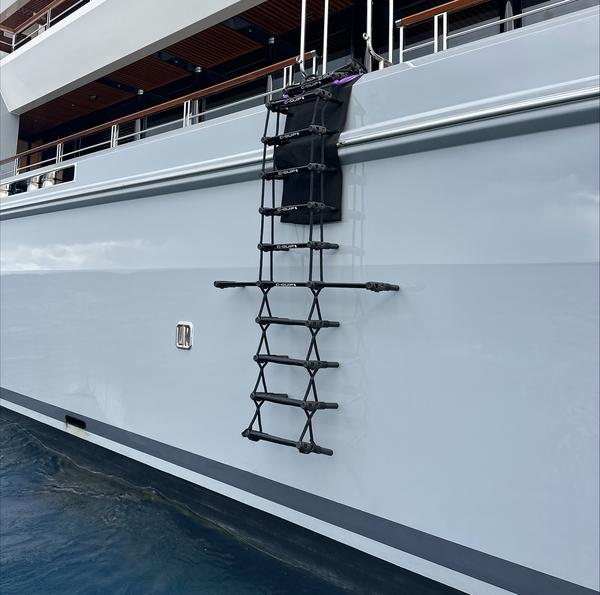
    C-Quip carbon fibre pilot ladder rigged over the side of a superyacht above the water

    Composite marine equipment / engineered to order

    Overview

    Overview

    Regulated access, made lighter to handle.

    C-Quip pilot and embarkation ladders combine carbon fibre construction with dimensions and configurations developed for regulated transfer arrangements, built to comply with SOLAS and ISO 799 requirements and certified by Lloyd's Register.

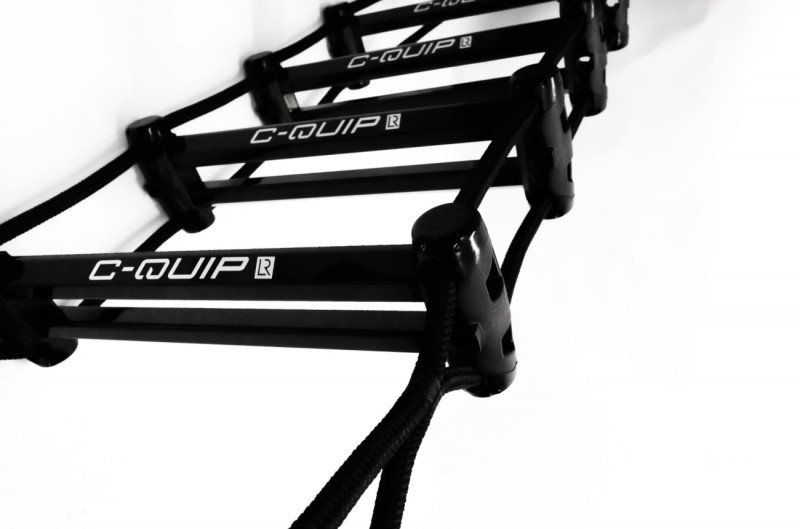
    Regulations require a pilot ladder to rest firmly against the ship's side. Horizontal spreaders and offset struts hold the ladder square and steady against the hull, including where a rub rail would otherwise force the ladder away from the topsides. Offset struts are a more elegant solution than cutting a rub rail or using a bulky inflatable fender against the hull. Soft bump pads protect the paintwork. The rungs are pre-preg carbon fibre with a non-slip finish and toughened polymer at the lower impact steps, and each one weighs less than 0.6 kg.

    Final selection and installation should be confirmed against the vessel's approved requirements.

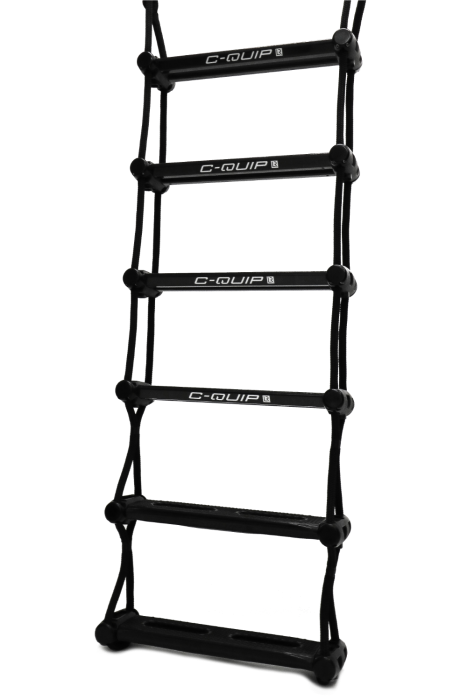
    C-Quip carbon fibre pilot ladder with horizontal spreader steps
    Weight per step
    < 0.6 kg

    Weight per step

    Step spacing
    330 mm

    Step spacing

    Spreader step width
    1,800 mm

    Spreader step width

    Stacked height per step
    85 mm

    Stacked height per step

    SOLAS

    Complies with SOLAS requirements

    ISO 799

    Complies with ISO 799

    Lloyd's Register

    Certified

    • —Complies with SOLAS and ISO 799 requirements, certified by Lloyd's Register
    • —Horizontal spreaders for stability
    • —Offset struts span the rub rail and maintain firm hull contact
    • —Split models available for longer configurations
    • —Soft bump pads protect the hull finish
    • —Carbon fibre steps weighing less than 0.6 kg each
    • —Non-slip step finish with light-reflective logo
    • —Toughened polymer lower impact steps
    • —Stackable steps for compact storage and fast deployment
    • —316 stainless steel or titanium fittings
    • —Storage rods and straps, or a wheeled carry bag

    Compliance

    Built to the rule, certified against it.

    C-Quip's pilot ladder is designed to comply with SOLAS and ISO 799 requirements and is certified by Lloyd's Register. Refer to current C-Quip certification and project documentation for the requirements and approvals applicable to each configuration.

    Standards
    SOLAS and ISO 799 pilot transfer arrangement requirements.
    Certification
    Certified by Lloyd's Register.
    Scope
    Pilot ladder use. Certificate scope confirmed project by project.
    Documentation
    Certificate and drawings available on request for tender and survey purposes.

    Certificate documentation is available on request for tender submissions and survey.

    Request certificate documentation

    Why it works

    Features

    Stability across difficult hull geometry, steps a single crew member can handle, and a ladder that stacks flat instead of coiling.

    < 0.6
    kg per step
    330
    mm step spacing
    1,800
    mm spreader width
    85
    mm stacked per step
    C-Quip carbon fibre pilot ladder rigged against a superyacht hull over the rub rail

    01

    Steady against a hull that isn't flat.

    Regulations require a pilot ladder to rest firmly against the ship's side. Superyacht topsides curve, flare and carry a rub rail at exactly the height a ladder wants to sit, pushing a conventional pilot ladder away from the hull so it twists and swings. Horizontal spreader steps hold the ladder square and stop it turning. Offset struts carry the ladder past the rub rail and keep the rungs in firm contact with the topsides, in many cases without the rail needing to be cut or interrupted. It is a more elegant solution than cutting a rub rail or wedging a bulky inflatable fender against the hull. Soft bump pads sit between the ladder and the hull to protect the finish.
    Close detail of a C-Quip carbon fibre pilot ladder step with light-reflective logo

    02

    Light enough to handle safely.

    Each C-Quip step weighs less than 0.6 kg. The steps are pre-preg carbon fibre monocoque with a non-slip finish and a light-reflective logo, with toughened polymer at the lower impact steps where the ladder meets the water and the hull. Fittings are 316 stainless steel or titanium, and the rope is specified to be comfortable in the hand for a climber who is gripping hard.

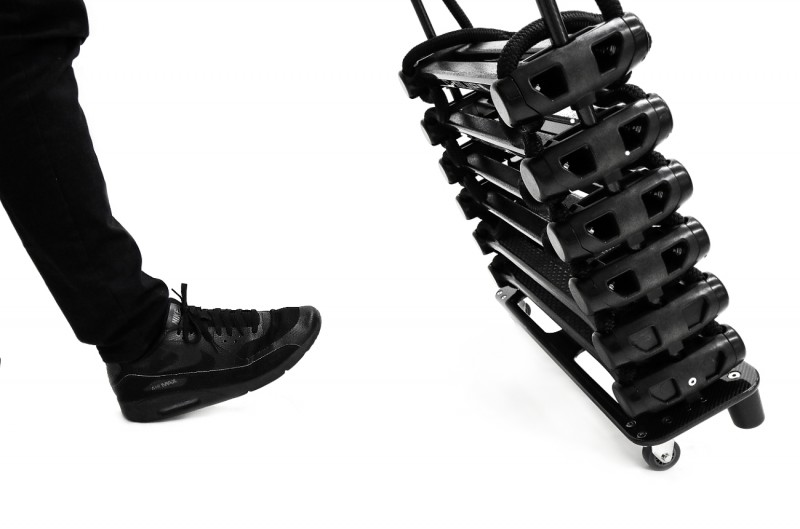
    C-Quip pilot ladder steps stacked flat on a wheeled trolley beside a crew member

    03

    Stacks flat instead of rolling up.

    A traditional pilot ladder is stored as a coil: bulky, heavy and awkward to move around a yacht. C-Quip's steps stack neatly on top of one another at 85 mm per step, so a ladder stores as a flat block rather than a roll. Stored length is calculated as the number of steps less one, multiplied by 85 mm. The stack is held with freestanding storage rods and straps, or carried in a wheeled bag that one crew member can move alone.

    Configurations

    Configured to the vessel's boarding arrangement.

    Ladder length, spreader positions, offset struts and hull stand-off are configured around the vessel's freeboard and boarding position, within the limits set by SOLAS and ISO 799. Split models are available for longer configurations, and configurations beyond 14 steps are possible on request.

    Render of a C-Quip carbon fibre pilot ladder with spreader step

    Ladder length

    Configured to the vessel's freeboard at the boarding position, from 6 to 14 steps as standard with larger configurations available. Extended length is the number of steps less one, multiplied by 330 mm.

    Horizontal spreader steps on a C-Quip carbon fibre pilot ladder

    Spreader steps

    Spreader steps are 1,800 mm wide and hold the ladder square against the hull.

    Detail of an offset strut fitting on a C-Quip pilot ladder

    Offset struts

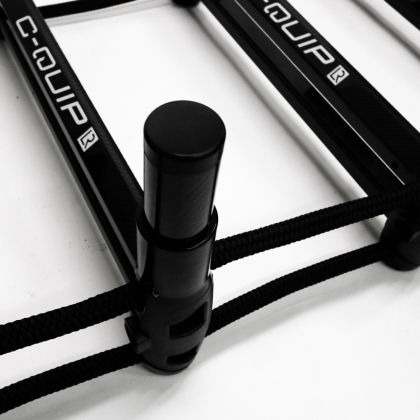
    Offset struts carry the ladder past the rub rail and maintain firm hull contact, so the rungs stay against the topsides rather than swinging clear. They are a more elegant solution than cutting a rub rail or using a bulky inflatable fender against the hull.

    Stacked C-Quip pilot ladder steps arranged for storage

    Storage

    Freestanding storage rods and straps hold the stack on deck, or the ladder travels in a wheeled carry bag that one crew member can move alone.

    Fittings
    316 stainless steel or titanium.
    Finish
    Clear-coated carbon fibre with a non-slip step finish and a light-reflective logo.
    Hull protection
    Soft bump pads sit between the ladder and the topsides to protect the finish.

    Questions

    Frequently asked.

    It is designed to comply with SOLAS and ISO 799 requirements and is certified by Lloyd's Register. Certificate documentation is available on request.

    Technical information

    Specifications at a glance.

    Compare construction details and dimensions below. Ladder length is configured to the vessel's freeboard, and stored and extended lengths are calculated from the step count.

    Construction

    Steps
    Pre-preg carbon fibre monocoque construction
    Lower impact steps
    Toughened polymer
    Fittings
    316 stainless steel or titanium
    Rope
    Hand-friendly specification
    Finish
    Clear-coated carbon fibre with light-reflective logo
    Spreaders
    Horizontal spreader steps, 1,800 mm wide
    Hull protection
    Soft bump pads
    Storage
    Stacking steps with rods and straps, or a wheeled carry bag
    Step configurations
    6 to 14 steps as standard, with larger configurations available on request
    Split models
    Most sizes can be split, with 12, 13 and 14-step configurations as standard
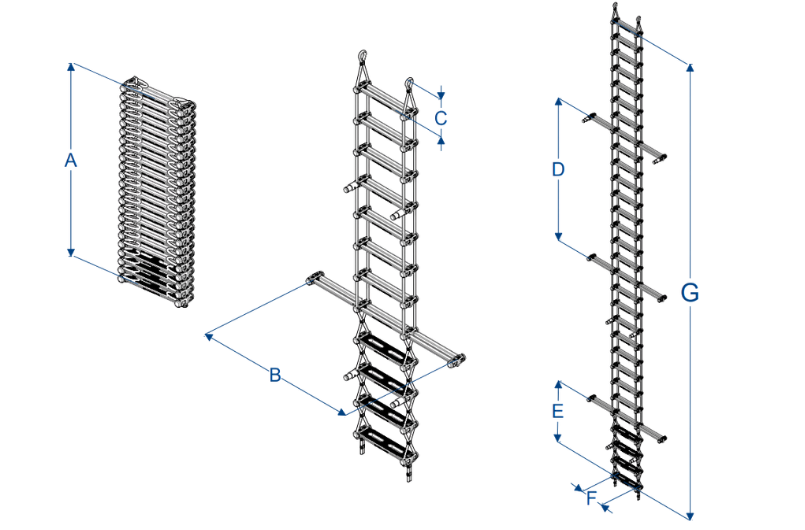
    Three-view technical illustration of a C-Quip pilot ladder showing stored length (A), spreader step width (B), step spacing (C) and (D), spreader interval (E), standard step width (F) and extended length (G)
    A: stored length. B: spreader step width. C: top step to eye. D: spacing between spreader steps. E: height of lowest spreader from base. F: standard step width. G: extended length.

    Dimensions

    Stored length (mm) · A
    Spreader step width (mm) · B
    Top step to eye (mm) · C
    Maximum allowable spacing between spreader steps (mm) · D
    Maximum allowable height of spreader step from base (mm) · E
    Standard step width (mm) · F
    Extended length (mm) · G
    Step spacing (mm)

    Stored and extended lengths are calculated from the step count. Step spacing, spreader width and spreader positions are set by SOLAS and ISO 799.

    Need the specification offline?

    Download the C-Quip Pilot Ladder fact sheet for technical reference, or request certificate documentation for tender and survey purposes.

    Download fact sheet

    Specify a pilot ladder for your vessel.

    Tell us about the vessel, the freeboard at the boarding position and the rub rail arrangement. The C-Quip team will help determine the appropriate ladder length, spreader positions, offset strut configuration and storage.